
Will Area Rugs Flatten Out?
Posted by Janice Wells on June 3, 2026
Will Area Rugs Flatten Out? - Here Is What You Need to Know
After more than 25 years in the area rug industry, I can tell you that this question comes up in almost every single consultation I do. A client receives their beautiful new rug, unrolls it, and notices it is not lying perfectly flat. The corners curl. There is a ridge down the middle where it was rolled. Or maybe they have had a rug for a while, and the pile has gone flat in the spots where everyone walks.
I completely understand the concern. You have invested in something beautiful for your home or office, and you want it to look its best. So let me walk you through everything you need to know, because the answer depends on what kind of flattening problem you are dealing with.
The New Rug: Creases, Rolls, and Curled Corners
Let's start with the most common situation. Your rug arrives rolled, you lay it out, and it does not lie flat right away. Corners curl up. There is a visible crease or ridge where it was packaged.
Here is the reassuring news: this is completely normal, and in almost every case, it resolves on its own with a little patience and the right approach.
Rugs are rolled and packaged under compression for shipping and storage. The fibers and backing need time to relax and adjust to your floor and your environment. Think of it like a piece of paper that has been rolled up. It takes a little time and gentle encouragement to lie flat again.
Note: Area rugs should never be folded. Be careful with chain stores, because we have had some horror stories of customers trying to save money, only to have their rug ruined by being folded.
Here is what I recommend for a new rug that is not lying flat:
Give it time first. Unroll it, lay it out in your space, and let it rest for a few days. Gravity and foot traffic do a lot of the work on their own.
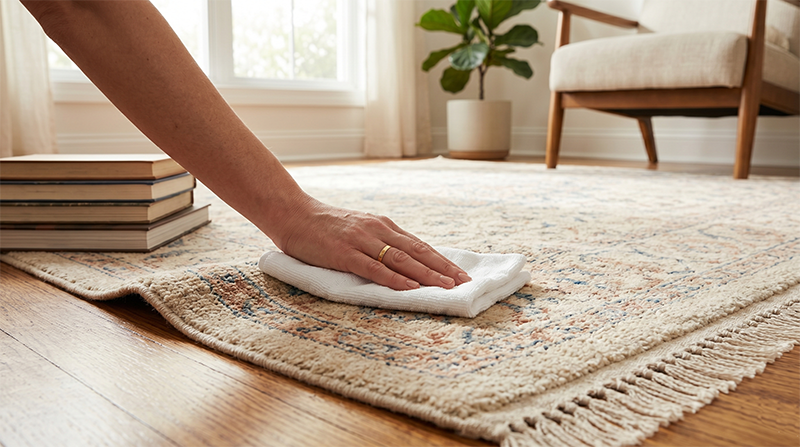
For stubborn curled corners, try reversing the roll. Gently fold the corners back in the opposite direction and hold them for a few minutes. You can also place something flat and heavy on the corners overnight, like a stack of books, to encourage them to relax.
If you have a crease or ridge down the center, try rolling the rug in the opposite direction and letting it sit for a day. A quality rug pad underneath also helps hold the rug down and significantly speeds up the flattening process. This is one of several reasons I always recommend a good pad.
For wool rugs, especially, a little light humidity can help. Some clients have success laying a damp towel over the stubborn area and letting it sit for an hour before smoothing it flat. The natural fibers respond beautifully to gentle moisture.
In warmer months, you can also place the rug flat in a warm room or even briefly in direct sunlight. The warmth relaxes the fibers, making them much more cooperative.
How Long Does It Actually Take?
Most new rugs settle and flatten within a few days to a couple of weeks with normal foot traffic. If your rug was tightly rolled for a long time during shipping or storage, it might take a bit longer, but I have never seen a quality rug that did not eventually relax beautifully with the right care.
The key variables are the rug's construction and materials. A flatweave rug tends to flatten out faster than a thick shag or a densely knotted wool rug. Synthetic rugs often respond quickly, while natural fiber rugs like jute or wool may need a little more patience.
If, after a few weeks, you are still seeing significant issues, reach out to us. That is what we are here for.
Pile Flattening: The Other Kind of Flat
Now, let me address a different situation entirely. This is when a rug that was once full and plush starts to look flat and worn in certain areas, particularly in high-traffic spots like hallways, entryways, and the paths people naturally walk through a room.
This is a different issue from the new rug creases, and it is worth understanding the difference.
Some degree of pile compression in high-traffic areas is normal and expected over time. That does not mean you have to live with it. There are simple ways to refresh your rug and bring life back to the pile.
Regular vacuuming is your best friend. Vacuuming in the direction of the pile lifts the fibers and prevents permanent compression. Many clients do not vacuum their rugs nearly as often as they should, and it shows over time. For most rugs in active households or offices, vacuuming once or twice a week in high-traffic areas makes a real difference.
Note: Be very careful of the more powerful vacuum cleaners with beater bars. These vacuums can damage your rug and should never be used. Instead, use a vacuum only to clean your rug.
Try ice cubes for furniture dents. If you have heavy furniture sitting on your rug and leaving deep indentations, place an ice cube directly on the dent and let it melt. As the water is absorbed and the fibers dry, they often spring back up beautifully. Then use a spoon or your fingers to gently lift the fibers.
A damp cloth and gentle heat work wonders. Dampen a clean cloth and lay it over the flattened area, then use a warm iron on a low setting over the cloth. Never apply the iron directly to the rug. The steam lifts the pile and refreshes the texture. This works especially well on wool and blended rugs.
Rotate your rug regularly. One of the best things you can do for a rug in a high-traffic space is to rotate it 180 degrees every six to twelve months. This distributes wear evenly across the entire surface and prevents any one area from flattening faster than the rest.
Does Rug Quality Affect How Well It Recovers?
Absolutely, and this is an important point. Higher-quality rugs with denser pile construction and higher fiber grades withstand compression significantly better than lower-quality options. They also recover more fully when you do need to revive them.
This is one of the reasons I am so particular about the brands and collections we carry at Rug Goddess. When you invest in a rug from a quality manufacturer like Stanton, Kaleen, or Momeni, you are getting a product built to maintain its appearance and structure under real-world conditions. The difference is noticeable, and it is one of the things I love most about being able to offer my clients access to these exclusive lines.
A rug you find at a big box store may look similar on the surface, but the construction, fiber density, and backing quality are often not in the same category. And those differences become very apparent over time in how the rug holds up, recovers from compression, and responds to care.
When Flattening Is a Sign of Something More
Occasionally, a flat or matted pile that does not respond to normal care can signal that a rug needs professional cleaning. Dirt and debris that work their way deep into the pile act almost like sandpaper, breaking down fibers from the inside and causing them to mat and flatten permanently over time.
If your rug has not been professionally cleaned in a few years and the pile looks dull and flat, professional cleaning is often the most effective solution. Many clients are amazed by how much life comes back to a rug after a thorough cleaning.
This is something I walk clients through during consultations, because proper care is part of getting the most out of your rug investment.
The Right Setup Makes All the Difference From Day One
Here is something I always tell my clients: how you set up a rug from the very beginning has a big impact on how it performs and looks over time.
A properly sized, high-quality rug pad is foundational. It cushions the pile from underneath, so fibers do not compress as hard against a rigid floor with every step. It keeps the rug flat and in position, so it is not constantly shifting and bunching. And it extends the life of your rug in ways that are very hard to replicate without one.
Getting your rug placement right, whether in a living room, a home office, a commercial lobby, or a workspace, is something I love to help with during a consultation. Seeing the space in person or virtually helps me ensure everything is set up for long-term beauty and performance.
The Bottom Line
Will area rugs flatten out after delivery? Yes, temporarily, and they almost always resolve with a little patience and the right techniques. Will the pile flatten over time with heavy use? Some compression is natural, but with proper care, rotation, and vacuuming, you can keep your rug looking full and beautiful for many years.
The key is to start with a quality rug, set it up correctly with a good pad, and care for it consistently. When you do all three, a well-chosen area rug can transform your space beautifully for a decade or more.
If you have questions about a rug you already own, or you are ready to find the perfect new rug for your home or office, I would love to help you through every step of the process.
Schedule your complimentary consultation today, in-home or virtual, and let us make sure you get it exactly right.
Visit ruggoddess.com, call us at 1-800-481-1572, or reach out to me personally at janice@ruggoddess.com. Your perfect rug, and the expertise to go with it, is right here waiting for you.
Janice Wells The Rug Goddess ruggoddess.com