

Custom Stair Runners: Size & Installation
Posted by Janice Wells on June 19, 2026
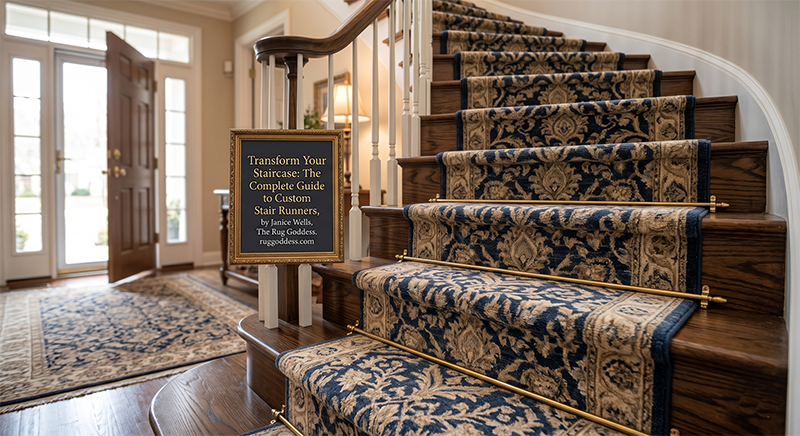
Stairway Runners
If there is one project that brings me the most joy after 20+ years in the area rug industry, it is helping a client transform a plain, hard, slippery staircase into one of the most beautiful focal points in their home. A new stair runner does exactly that. It softens every step, quiets the entire home, and pulls your design together from the entryway throughout the dwelling. Let me walk you through everything you need to know to make a confident, beautiful choice for your staircase.
Why You Might Want a Stair Runner
A bare wood or laminate staircase looks lovely in photos, but living with one is a different story. Here is what a well-chosen runner can accomplish for you.
Not only does it add safety, but hard stairs are also slick, especially in socks, and they can be a real hazard for children, older family members, and pets. A stair runner gives you traction on every step.
It reduces noise. Stairs are one of the loudest spots in any building or home. A runner absorbs sound, so footsteps stop echoing throughout, and an office stairwell feels calmer, quieter, and more professional.
It protects your stairs. Treads take a beating over the years. A runner shields the wood underneath and keeps it looking fresh and new.
And of course, it transforms the look of your space. The staircase is often the first thing people see when they walk in. The right runner makes it warm, finished, and unmistakably yours.
What Makes a Great Stair Runner (and the Brands I Trust)
Not every rug belongs on a staircase. Stairs are high-traffic, high-wear zones, so you want a runner that is durable, holds its shape, and looks beautiful step after step. You want to use either a roll runner meant for stairs or broadloom material with some give or flexibility that will easily fold over the stair tread. You do not want to use material that is hard and doesn’t bend.
Over the years, I have come to rely on a few exceptional partners for stair runners. Stanton, Couristan, and Nourison are three of my favorites because they offer high-quality, gorgeous patterns with rich textures in constructions built to handle daily traffic. Most of their broadloom material can also be cut and finished on the sides to create custom runners of any width, giving you tremendous flexibility and hundreds of options.
When I help a client choose a stair runner, I first look at the fiber, then pile height, and then the pattern repeat. A tighter, lower pile tends to wear better on stairs and is easier to install cleanly around each bullnose. The pattern matters too, because it has to flow uniformly from step to step. I will get into why that is so important when we talk about installation, especially where you start the runner at the base, the most visible point.
How to Pick the Right Width
Width is the decision people most often second-guess, so let me make it simple. The goal is to leave an attractive, even margin of finished stair showing on each side of the runner. As a rule of thumb, you want roughly 3 to 4 inches of exposed tread on either side, though your exact stair width and the look you are after will guide the final call.
Standard roll runners come in these widths:
- 26-27 inches
- 30-31 inches
- 36 inches
- 41 inches
This is exactly the kind of detail where an in-home consultation or virtual consultation will pay off. I will oversee measuring with you, look at your stair width and the surrounding space, and help you land on the perfect size that frames your steps beautifully.
Custom Options: When Standard Size Roll Runners Need Adjusting
Here is something many people do not think about that can save you time and, usually, quite a bit of money.
Let’s say your staircase requires a 29-inch roll runner for the perfect fit, but the one you love only comes in standard 30- or 31-inch-wide width. In many cases, we can simply trim the same amount from each side and re-serge both sides to custom-make the perfect 29-inch runner. The only condition is that the design or pattern cannot be negatively affected by the cut. If trimming the edges removed some of the border or threw the pattern completely off balance, we could not do this. But when the design allows, this small adjustment gives you the exact width you need and is often more affordable than using broadloom.
When a standard roll runner truly will not work, we simply move to a custom solution.
Building a Custom Runner Using Broadloom
For unusual widths, oversized stairs, or a look you cannot find off the shelf, we create a custom runner by cutting broadloom carpet down to your exact dimensions and finishing the edges. This is one of our specialties, and it opens up countless beautiful possibilities.
The way we finish those cut edges matters, and the right method depends on how the runner will be used:
For residential runners, I usually recommend to serge the edges. Serging wraps the edge in yarn with a hand-stitched look that is elegant and well-suited to a residential home setting.
For commercial and office runners, I typically recommend binding the edges. Binding applies a fabric or synthetic tape along the edge of the runner, which is more rugged and stands up beautifully to the heavy foot traffic, such as a workplace stairwell used daily.
Whether your project is for a home or an office, we will choose the finish that strikes the right balance of beauty and durability.
Always Order a Little Extra
Please do not skip this one. Whenever you are doing a runner project, always buy a bit more material than you think you need.
Stairs have a way of surprising you during installation, and the last thing you want is to run out of material partway through. Here is the catch: if you run short and must reorder later, it is often very difficult to get an exact match, especially on the dye lot color and pile. Dye lots can vary, and even the same product can look slightly different from run to run. Ordering a little extra up front protects you from that headache and gives your installer room to match the pattern properly, especially at the most visible point, the beginning of the stairs. It is also smart to have a little extra material for any future accidents or damage to a step or two.
The Importance of a Quality Rug Pad
A proper pad underneath your stair runner is not optional.
A good rug pad does two essential things.
It keeps your runner from shifting, which is a genuine safety issue on stairs. A shifting runner can cause a fall, and that is exactly what we try to prevent. Using a good rug pad is much like using a high-quality pad under wall-to-wall carpeting; it keeps the material from stretching out of shape.
It cushions every step, which adds comfort. We carry high-quality pads in standard sizes that your installer can cut to fit any stair runner installation, and Rug Goddess will make sure yours is the right one for the job!
A Beautiful Traditional Touch: Decorative Stair Rods
If your home leans traditional or elegant, you may love the look of decorative stair rods. These polished metal bars sit in the crease between the tread and the riser, holding the runner in place with a refined, timeless feel. They are a wonderful detail in formal entryways and classic interiors, or older homes you are remodeling to make them look original, and they give your staircase a custom, more formal look.
How a Stair Runner Is Installed
While I always recommend a professional for this work, it helps to understand what goes into a proper installation. Here are the basic steps.
- Prepare the stairs. The treads and risers are cleaned and checked, and any old tack strips or staples are removed so you start with a clean, fresh surface.
- Lay the rug pad. Pads are cut for each tread and secured so they sit flush and do not extend past where the runner will cover. Generally, about 1 inch in from each edge of the runner material.
- Position and align the runner. The runner is centered, so the margins are even on both sides, and the pattern is aligned so it flows uniformly up the staircase.
- Secure the runner step by step with the proper carpet staple gun. Working from the bottom up, the installer fastens the runner into the crease where each tread meets each riser, smoothing it tight against every step so there are no ripples or gaps.
- Finish and inspect. The top and bottom edges are tucked and secured, and the whole run is checked for tension, alignment, and a clean, even look.
Curved Staircases and Landings
This is where stair runner work goes from straightforward to a specialized installation and where expertise truly earns its keep.
Curved or winding staircases do not have uniform steps. The treads are wider on the outside of the curve and narrow toward the inside, so the runner has to be carefully shaped and fitted to each individual step rather than simply rolled out. This often requires cutting and finishing custom pieces for the curved sections, so everything lies flat and looks intentional.
Landings add their own consideration. The runner has to transition cleanly across the flat landing surface and continue up the next flight while keeping the pattern aligned the whole way. Done well, it looks seamless. Done poorly, the eye catches every misstep. Best practice is to always use a professional installer for curved or specialty staircases.
Find a Qualified Installer
I cannot stress this enough: please use an experienced, qualified installer for your stair runner, especially if you have a curved staircase or a patterned runner, and include a landing that requires curves or miters.
A patterned runner must flow correctly at the beginning and stay uniform from step to step. If the pattern is not taken into consideration at the beginning, it is noticeable on every single stair, and it is the kind of mistake that is very hard to undo once the runner is fastened down with a staple gun. Curved stairs raise the difficulty even further. This work calls for real skill, and a seasoned installer makes all the difference between a staircase you are proud of and one you wish you could redo.
Let's Find the Perfect Runner for Your Space, Together
Choosing a stair runner involves a lot of decisions, including width, pattern, finish, pad, and installation, and they all have to come together just right. The good news is that you do not have to figure it out alone. Helping clients get this exactly right is something I have been doing for more than 25 years.
I would love to guide you through it. We can talk through your staircase, look at exclusive collections from our partners and explore custom options if you require them.
For more information and examples, check out our page on stair runners.
Schedule your consultation today, in-home or virtual, whatever works best for you.
- Visit ruggoddess.com
- Call 1-352-503-9410
- Email Janice@ruggoddess.com
Let's transform your staircase into something you love coming home to.