
What to Do with Your Old Area Rug?
Posted by Janice Wells on June 11, 2026
In 25 years of helping clients transform their homes and offices with beautiful area rugs, I have heard every version of this question. You have a rug that no longer works for you, and you are not quite sure what to do with it. Maybe you just moved into a new home, and the color palette is completely different. Maybe you inherited a rug from a family member and simply do not have the space. Maybe your current rug has served you faithfully for years, and it is finally time to say goodbye.
Whatever the reason, figuring out what to do with an old area rug can feel surprisingly overwhelming. You do not want to just throw it away if it still has life left in it, but you also may not know where to start.
I put this guide together to walk you through your options, from donation to repurposing to disposal, so you can make the choice that feels right for your situation.
First: Why Are You Ready to Part With It?
Understanding why you want to let go of your rug actually helps you figure out the best path forward. Here are the most common situations I hear from clients, each pointing to a slightly different solution.
Your new home has a different color palette. This is one of the most common reasons clients come to me for a new rug. The rug that looked perfect in your last home simply does not work with your new paint colors, flooring, or furniture. The rug itself may be in beautiful condition. It just no longer belongs in your space.
You inherited a rug and do not have room for it. Many families have meaningful rugs passed down through generations. Persian rugs, traditional wool pieces, handwoven heirlooms. Sometimes the rug is beautiful, but the space simply does not accommodate it, or the style does not fit your home.
Your rug is showing its age. Even the best rugs eventually show wear. Fraying edges, thinning pile, fading color, or backing that is starting to break down are all signs that a rug has reached the end of its useful life in your home. That does not necessarily mean it is worthless, but it does affect your options.
You are upgrading to something better. Sometimes clients simply want something new. A different style, a custom size, an exclusive collection piece that better reflects where their taste has evolved. This is one of my favorite reasons to hear, because it usually means a fun consultation is coming.
Your lifestyle has changed. A rug that worked beautifully before you had children or pets may no longer be practical. Or a commercial space has evolved, and the original rug no longer fits the company’s aesthetic.
You received it as a gift, and it was never quite right. It happens. Someone gifted you a rug with the best intentions, and you have kept it out of politeness. It is okay to find it a better home.
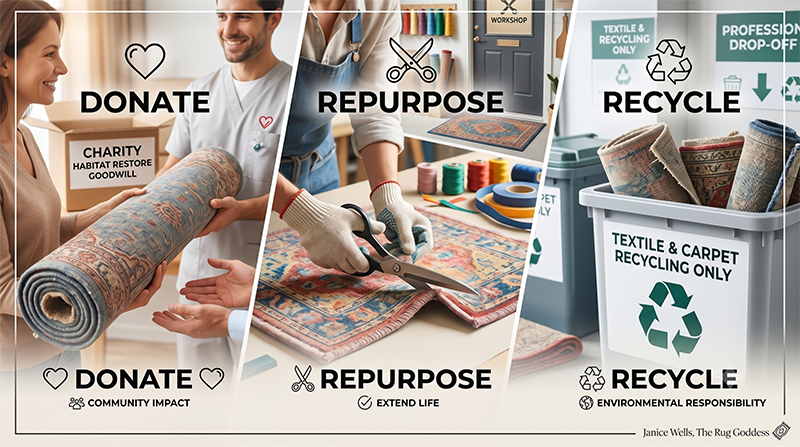
Option One: Donate Your Rug to Someone Who Needs It
If your rug is still in reasonably good condition, donation is almost always my first recommendation. A rug that no longer works for your space could be exactly what someone else needs, and keeping it out of the landfill is always a worthwhile goal.
Here are some of the best donation options to consider.
Goodwill Industries. Goodwill accepts area rugs at most donation centers, provided they are clean and in usable condition. Their network is nationwide, which makes them an accessible option for most people. Call your local Goodwill ahead of time to confirm their current guidelines, as policies can vary by location.
Habitat for Humanity ReStores. This is one of my favorite recommendations for rugs in good condition. Habitat for Humanity ReStores accept home furnishings and building materials, including area rugs, and the proceeds fund affordable housing construction. You are giving your rug a second life while supporting a meaningful cause.
The Salvation Army. The Salvation Army accepts furniture and home goods donations at many of their Family Stores across the country. Like Goodwill, they ask that items be clean and in usable condition. Their donation proceeds fund a wide range of community assistance programs.
Local shelters and transitional housing programs. Women's shelters, homeless shelters, and transitional housing organizations often have an ongoing need for rugs and home goods. A quick call to organizations in your area can connect your rug directly with someone setting up a new home from scratch. This is one of the most immediate and personal ways your rug can make a difference.
Veterans organizations. Many organizations that support veterans and military families furnish homes for those transitioning out of service or experiencing hardship. Volunteers of America and similar groups often accept home furnishings, including area rugs.
Local Buy Nothing groups and community exchanges. Facebook Buy Nothing groups and Nextdoor neighborhood exchanges are wonderful ways to give a rug directly to someone in your community who can use it. You post, someone nearby claims it, and the rug stays local. This is fast, easy, and incredibly satisfying.
Furniture banks. Many cities have furniture banks, which are nonprofits specifically focused on furnishing homes for people in need. A quick search for "furniture bank" plus your city name will tell you if one operates near you.
Animal shelters. This one surprises people, but many animal shelters gladly accept old rugs, especially those that are a bit worn. They use them for bedding and comfort in kennels and adoption areas. Even a rug that is too worn for a human home may be perfect for a sheltered animal.
Just keep in mind that depending on the type of area rug you have, they can be quite heavy, so it's always a good idea to make sure someone is at your preferred location to accept your rug.
Option Two: Repurpose or Upcycle Your Rug
Before you donate or dispose of a rug, consider whether it has a second life within your own world or someone else's creative vision.
Cut it down for a smaller space. A large rug that does not work in your living room may be perfect cut down to fit a hallway, mudroom, or garage workshop. If the rug has a bound edge, you will want to have it professionally re-bound after cutting, which a rug or carpet professional can handle. This is a surprisingly affordable option that extends the life of a quality rug.
Use it in a garage or workshop. An old rug that is too worn for your main living space can be genuinely useful in a garage, workshop, or utility space. It provides cushioning underfoot, reduces fatigue during long projects, and adds a layer of insulation to cold concrete floors.
Repurpose it for outdoor use. Some rugs, particularly those made with synthetic fibers, transition beautifully to covered outdoor spaces like screened porches, decks, or patios. Even a rug not originally designed for outdoor use can work well in a covered, protected area.
Donate it to a theater or film set. Local theater companies, film schools, and community arts organizations frequently need props and set dressing. A rug with character, even one showing some wear, may be exactly what a set designer is looking for.
Pass it along to a college student or young renter. Young people setting up their first apartments are often working with tight budgets and are happy to receive a rug in any condition. Post it in a local college community group or hand it directly to someone you know who is just getting started.
Option Three: Recycle Your Rug Responsibly
When a rug is truly at the end of its useful life and donation is not appropriate, responsible recycling is a much better choice than sending it straight to a landfill. Rugs can be bulky and slow to decompose, so keeping them out of the waste stream matters.
Here are the recycling options worth knowing about.
Check with your local waste management provider. Some municipalities have special collection days or drop-off programs for large textiles and floor coverings. Before you do anything else, check with your local waste management service to see what options exist in your area.
Carpet America Recovery Effort (CARE). CARE is a nonprofit organization dedicated to keeping carpet and rug materials out of landfills. They operate a network of collection and recycling sites across the United States. Their website allows you to search for drop-off locations near you. Not all sites accept area rugs, as opposed to wall-to-wall carpet, so it is worth confirming before you make the trip.
Earth911. Earth911 is a comprehensive recycling resource that lets you search by material type and zip code to find recycling options near you. Searching for "carpet" or "textiles" in your area will surface local options you may not have known existed.
Textile recycling programs. Many communities have textile recycling bins or programs that accept clothing, linens, and home textiles, including some rugs. Companies like USAgain and similar textile recyclers operate drop-off bins in parking lots and shopping centers across the country. These programs divert textiles from landfills and often repurpose materials into insulation, padding, and industrial products.
Manufacturer take-back programs. Some rug and carpet manufacturers have take-back or recycling programs for their products at the end of their useful life. If you know the brand of your rug, it is worth checking their website or calling their customer service line to ask.
Synthetic rugs and carpet padding. Polypropylene, nylon, and other synthetic rug materials can often be recycled into new products, including carpet padding, automotive parts, and construction materials. The key is finding a facility that accepts these specific materials, which is where Earth911 and CARE are most helpful.
Natural fiber options. Wool, cotton, jute, and other natural fiber rugs can sometimes be composted if they are free of synthetic backing. Pure natural fiber rugs will break down over time in a commercial composting facility. Check with your local composting program to see if they accept textiles.
A Note on Rugs That Might Be Worth More Than You Think
Before you donate or dispose of an older rug, especially one you inherited, I want to offer one important piece of advice: have it evaluated first.
Antique Persian rugs, handwoven oriental rugs, and certain vintage pieces can have significant value that is not obvious to the untrained eye. I have seen clients nearly give away rugs that turned out to be quite valuable.
If you have an older rug, particularly one that appears to be handwoven with natural dyes and intricate patterns, it is worth having an expert take a look before you let it go. A reputable rug dealer or auction house can give you a sense of whether it has resale or appraisal value.
Ready to Replace It? Let Us Help You Find What Comes Next
Here is the part where I love to come in. Once you know your old rug is taken care of, whether it is headed to a new home, a shelter, or a recycling program, the fun part begins: finding what comes next for your space.
This is exactly what I do every day. I help homeowners and commercial clients find area rugs perfectly suited to their space, style, and lifestyle. Through in-home and virtual consultations, I bring 25 years of specialized expertise directly to you, along with access to exclusive collections and custom capabilities that you simply will not find anywhere else.
Our RoomVo room visualizer lets you upload a photo of your space and see exactly how a new rug will look before you commit to anything. And I stay with you every step of the way, from that first conversation through delivery and installation, because that is what the Rug Goddess difference is all about.
Schedule your complimentary consultation today, in-home or virtual, and let us find the perfect rug for your next chapter.
Visit ruggoddess.com, call us at 1-800-481-1572, or reach out to me personally at janice@ruggoddess.com. I would love to help you transform your space.
Janice Wells The Rug Goddess ruggoddess.com