
Where Should an Area Rug Be Placed in a Room?
Posted by Janice Wells on June 17, 2026
Your Complete Room-by-Room Size and Placement Guide
If there is one question I have answered more than almost any other in my 25 years of working with area rugs, it is this: "How big should my rug be, and exactly where should it go?"
It sounds simple. It is actually one of the most important design decisions you can make for a room, and getting it wrong is one of the most common mistakes I see, even in otherwise beautifully decorated spaces. A rug that is too small makes a room feel disconnected and unsettled. A poorly positioned rug throws off the entire balance of a furniture arrangement. And a rug that is sized and placed just right, It pulls everything together in a way that feels almost magical.
I want to give you a genuinely useful, room-by-room guide to rug placement and sizing because this is the kind of knowledge that transforms not just your rug purchase but your entire approach to room design. Let's go through it together.
The Single Most Important Rule in Rug Sizing
Before we get into specific rooms, I want to share the one principle that underlies every sizing decision I make for clients.
When in doubt, go larger.
This is the most consistent piece of advice I give, and it is the most consistently ignored one. Almost every sizing mistake I see in client homes involves a rug that is too small for the space. A too-small rug floats in the middle of the room like an afterthought. It disconnects furniture from the surrounding space. It makes ceilings feel lower, and rooms feel less finished.
A larger rug, on the other hand, anchors the room. It defines the space. It makes the room feel more intentional, more cohesive, and yes, often larger and more open, not smaller. I will come back to this point when we talk about the smaller-versus-larger rug debate, because it is worth understanding the design psychology behind it.
But first, let's talk about each room specifically.
The Living Room: Where Rug Placement Matters Most
The living room is where most of my clients feel the most uncertain about rug sizing and placement, and it is also where the impact of getting it right is most dramatic.
The three placement approaches
In the living room, there are three accepted approaches to rug placement relative to your furniture. Which work is right for you depends on your room size, your furniture arrangement, and the look you are going for.
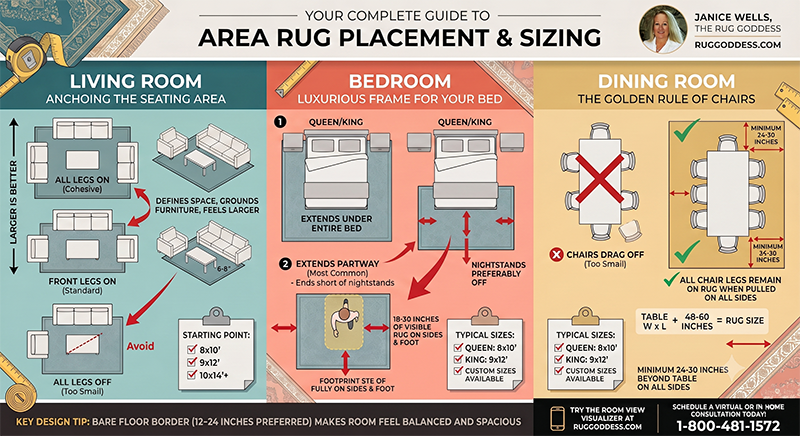
All legs on the rug. This is the most cohesive and visually unified option. Every piece of furniture in the seating arrangement, your sofa, chairs, and coffee table, sits with all four legs on the rug. This approach requires a larger rug and creates a beautifully contained, intentional seating area. It is my personal favorite for most living rooms because it reads as the most polished and deliberate, especially in a room with high ceilings and a large open floor plan.
Front legs on the rug only. This is the most common approach and works beautifully in most standard living rooms. The front two legs of your sofa and chairs rest on the rug, while the back legs sit on the floor behind. This visually connects the furniture to the rug without requiring a rug as large as the all-legs approach. This approach works best when you have a standard ceiling height and an average-sized living room, but less so in an open-concept home.
All legs off the rug. In this approach, the rug sits entirely under the coffee table, and no furniture legs rest on it at all. This only works well in very small rooms or with very specific furniture arrangements. In most spaces, it reads as the rug being too small. I generally advise against this option unless the room truly demands it and it is a very modern, minimalist setting, such as a small contemporary condo or tiny apartment home.
How far under the sofa should the rug go?
For the front-legs-on approach, which is the most widely applicable, you want the front legs of your sofa sitting approximately 6 to 8 inches onto the rug. This creates a clear visual connection between the furniture and the rug without requiring the rug to extend all the way under the sofa.
For the all-legs-on approach, your sofa legs should sit comfortably on the rug with the rug extending at least 6 to 8 inches beyond the back legs of the sofa before reaching the floor. This ensures the rug looks intentionally sized rather than barely fitting.
How far under the living room chairs should the rug go?
For accent chairs and armchairs in the seating group, the same principle applies. With the front-legs-on approach, the front two legs of each chair should rest on the rug, with the front legs about 6 inches onto it. This visually connects the chairs to the sofa and the central seating arrangement, creating a unified grouping.
If your chairs are positioned across from the sofa, which is common in a conversational arrangement, the rug should be large enough so that both chairs and the sofa all have their front legs on the rug simultaneously. This is where people most often discover their rug is too small. The solution is almost always a larger rug.
What size rug works in the living room?
For most standard living rooms, an 8 x 10-foot rug is the starting point, not the ending point. In many rooms, a 9 x 12 is often the better choice, and in larger or more open-concept living spaces, a 10 x 14 or larger is often what the room genuinely needs.
The most common mistake I see is a client choosing a 5 x 8 rug for a living room that needs an 8 x 10, or a 6 x 9, when a 9 x 12 is the right answer. The smaller rug looked reasonable online or in the store, but in the actual room, surrounded by full-sized furniture, it simply disappears.
A good starting point is to measure your seating arrangement, the area bounded by your sofa and chairs, and then choose a rug that extends at least 12 to 18 inches beyond the furniture on the sides that face into the room. The border of the rug, visible around the furniture, creates an anchored, grounded look for all the furniture pieces.
The Bedroom: Creating a Soft, Luxurious Frame Around Your Bed
The bedroom is one of my favorite rooms to work with because the rug placement here has such a direct impact on how the room feels first thing in the morning and last thing at night. Stepping out of bed onto a beautiful, soft rug sets the tone for everything that follows.
There are three bedroom placement approaches
The rug extends under the entire bed. This is the most luxurious and visually generous option. The rug extends well under the bed on all sides, with a significant border visible along the sides and foot of the bed. This approach works best with larger rugs in larger rooms and with higher ceilings, creating a beautifully unified, hotel-like quality.
Rug extends partway under the bed. This is the most common and practical approach for most average bedrooms. The rug slides under the bed far enough to anchor it visually, but does not need to extend to the headboard end; it can stop just short of the nightstands.
Two runners, one on each side. In rooms where a large rug does not make sense, or where the bed is positioned against a wall with limited walking space, placing a runner on each side of the bed is a lovely alternative that still provides added warmth and a soft landing when you get up.
How far should the rug extend from under the bed?
This is the question I hear most often about bedroom placement, and the answer depends on which approach you are using.
For the most popular approach, where the rug extends partway under the bed, I recommend sliding the rug under the bed so that approximately 18 to 30 inches of rug is visible on each side of the bed and at the foot. That 18 to 30 inches of exposed rug at the sides is what you step onto when you get up, and it is what creates that warm, grounded feeling in the room. If you are doing a bench at the end of the bed, you would also want that bench to be completely on the rug.
For a king or queen bed, the rug should extend far enough beyond the sides of the bed that when you are standing beside the bed, you are standing fully on the rug, not half on the rug and half on the floor. Nothing disrupts the luxurious quality of a beautiful bedroom rug faster than stepping half off it. I prefer to extend the rug to match or nearly match the length of the nightstands.
At the foot of the bed, aim for at least 18 inches of rug extending beyond the foot of the bed frame. More is better here if the room allows it; on occasion, it does not.
What size rug works in a bedroom?
For a king bed, I would recommend a minimum of 8 x 10, and a 9 x 12 is often the right choice. This is also where using finer broadloom material to custom-cut an area rug often comes into play. For instance, sometimes a 7 ft. x 12 ft. rug is the perfect size for the space, and by using broadloom, you can achieve it.
For a queen bed, an 8 x 10 works well in most rooms. For a full or twin, a 6 x 9 or 8 x 10, depending on the overall room size.
If your room is large, do not be afraid to go up to a 10 x 14 rug or even a custom size. A rug that fills a generously sized primary master bedroom creates an enveloping, luxurious, hotel-quality feel you feel every single day.
Nightstands can sit either on or off the rug. I prefer off, but both approaches work, and it often comes down to the size of your nightstands and how far they extend past the side of the bed. On occasion, it is preferable for the nightstands to sit partially on the rug, as it creates continuity across the entire bed wall, especially if the nightstands are large and the ceilings are high.
The Dining Room: Where Function and Proportion Both Matter
The dining room has a very specific functional requirement that shapes every size decision: the rug must be large enough that chairs remain on the rug even when they are pulled out for someone to sit down. This is the rule I see violated most often in dining rooms, and it creates both a visual problem and a practical one.
The fundamental dining room rule
Every chair must remain fully on the rug even when pulled out from the table. When a chair is pulled back enough for a person to sit comfortably, all four legs of that chair should still be resting on the rug, not half on, half off, and certainly not fully off.
When dining chairs drag off the edge of the rug with every meal, the rug edges fray and curl, the rug shifts constantly, and the whole arrangement looks unintentional. Getting the size right from the start eliminates all of this.
How far should the rug extend beyond the dining table?
I recommend a minimum of 24-30 inches of rug extending beyond the edge of your dining table on all sides. This gives you enough room for chairs to be pulled out fully while keeping all four legs on the rug. If your dining chairs are particularly large and have arms, or if you have a lot of chairs, 30 inches on each side is even better.
The way to calculate this is straightforward. Measure your dining table length and width. Add 48 to 60 inches to each dimension (24 to 30 inches per side). That gives you the minimum rug size for your table. There are a few exceptions if your room is particularly small, but it's not best practice.
For example, a standard 60-inch rectangular dining table that is 36 inches wide calls for a rug that is at minimum 8 feet wide and 9 or 10 feet long. Many clients are surprised by how large that is. But once they see it in the room with the table, the proportion is immediately clear and correct.
What size rug works in a dining room?
For a table seating 4 to 6 people, an 8 x 10 is typically the starting point. For a table seating 6 to 8, a 9 x 12 is usually more appropriate. For larger tables or extended-family dining rooms, a 10 x 14 or a custom size may be exactly what the room needs.
Round dining tables pair beautifully with round or square rugs when the room allows. The rug should be large enough that all chairs remain on it when pulled out, following the same 24–30-inch extension rule on all sides, with or without arms on the chairs.
This is one of the areas where our custom rug capability is genuinely invaluable. Not every dining room is a standard rectangle, and not every table is a standard size. We can create the exact size and shape your dining room requires, something the biggest retail stores cannot offer.
Smaller Rug or Larger Rug: Which Is Better?
I touched on this at the beginning, but I want to give you the full picture because it is one of the most genuinely useful things I can share.
The case for going larger
A larger rug almost always makes a room feel better. Here is the design psychology behind it.
A rug that is properly scaled to the room creates a visual frame for the furniture arrangement. The border of the floor visible between the rug and the walls acts as a mat around a painting, containing and showcasing the furniture within it. This makes the room feel larger, not smaller, because the eye reads the proportions as intentional and spacious.
A larger rug also makes furniture feel grounded. When furniture floats on a small rug surrounded by a sea of bare floor, nothing feels settled or connected. This is why a rug under a coffee table is quite lost. A properly sized rug ties the elements of the room together and gives everything a sense of belonging.
From a practical standpoint, a larger rug is more forgiving. If your furniture arrangement often shifts slightly, a larger rug accommodates it. A smaller rug punishes every inch of misalignment, making the space feel out of balance and cluttered.
The case for a smaller rug
There are legitimate reasons to choose a smaller rug in certain situations.
In a very small room, a large rug can feel visually heavy, leaving no breathing room between it and the walls. For small spaces, it is worth considering whether you want a rug that fills most of the room, creating a cohesive carpet-like effect, or a smaller rug that defines just one zone within the space, like a sitting area. Smaller rugs are also considered when walkways need to be completely clear, such as in an elderly person’s living space.
Budget is a real consideration. A larger, higher-quality rug is a more significant investment. If the choice is between a very large, lower-quality rug and a properly sized, higher-quality rug, I will always guide clients toward the higher-quality option, even if it means adjusting the size slightly.
In rooms with particularly beautiful, unique flooring, a smaller rug used intentionally can showcase the floor rather than covering it. This is a legitimate design choice when the floor itself is part of the aesthetic.
How to pick the right size: my practical approach
Here is the method I walk clients through in every consultation.
Start by measuring your room. Write down the dimensions.
Identify the furniture arrangement the rug needs to anchor. For a living room, that is your seating group. For a dining room, your table and chairs. For a bedroom, your bed.
Apply the appropriate placement rules for that room, as outlined above, to determine the minimum rug size needed to fit the space.
Then consider going one size up from that minimum. In most cases, the larger size looks better.
Use painter's tape on your floor to map out both the minimum size and the larger option. Live with the tape for one day and see which one feels right in the actual space. This is one of my favorite low-tech tips and it is remarkably effective.
If you are still unsure, please use our room-view visualizer at ruggoddess.com. You upload a photo of your actual room and see exactly how different rug sizes and styles look in your space before you commit to anything. It takes the guesswork entirely out of the process.
The software is not perfect, but it really helps!
The Bare Floor Border: How Much Should Show?
A question I receive alongside the size question is how much bare floor should be visible between the edge of the rug and the walls of the room.
The generally accepted range is 12 to 24 inches of bare floor showing on all sides between the rug edge and the wall. In most rooms, 18 inches is a beautiful, balanced proportion. Less than 12 inches can make the room feel like the rug is wall-to-wall carpet. More than 24 inches can make the rug feel too small and unconnected to anything.
In smaller rooms, the border can be closer to 12 inches. In larger, more generous rooms, 18 to 24 inches reads beautifully and gives the room a sense of scale and proportion.
This is another area where custom sizing is a genuine advantage. Standard rug sizes are designed around average room dimensions, but your room may not be average. If you need a 10 x 13 to achieve the perfect 18-inch border on all sides of your 14 x 17 room, that is exactly the kind of custom solution we create every day.
One Final Thought on Size and Placement
Getting the size and placement right is genuinely one of the highest-impact things you can do for a room. It does not require renovation or new furniture. It requires the right rug in the right place, and with 25 years of experience doing exactly this for homes and offices across the country, I can tell you that the difference between a well-placed rug and a poorly placed one can completely transform a space.
This is also one of the areas where an expert eye makes the most difference. I have entered rooms where a beautiful, high-quality rug made the space look worse than no rug at all, simply because the size and placement were not correct. And I have watched those same rooms come completely alive the moment we replaced it with the right piece and size in the right position.
If you are working through these decisions right now, for a living room, bedroom, dining room, or any other space in your home or office, I would love to help you get it exactly right. Our in-home and virtual consultations are designed precisely for this kind of guidance. I will look at your space, understand your furniture arrangement, and help you find the perfect rug in the perfect size from our exclusive collections, including custom options in any dimension you require.
Our room view visualizer at ruggoddess.com is also a wonderful place to start. Upload a photo of your room and see how different sizes and styles look in your actual space before you make any rug decisions.
Schedule your consultation today, in-home or virtual, and let us take the guesswork out of finding your perfect rug.
Visit ruggoddess.com, call us at 1-800-481-1572, or reach out to me personally at janice@ruggoddess.com. Getting the size and placement right is what I love to help with most, and I am here for every step of the process.
Janice Wells, the Rug Goddess ruggoddess.com