
The Complete Area Rug Size Guide
Posted by Janice Wells on July 1, 2026
How to Choose the Right Size Rug for Every Room
After 20+ years of helping homeowners and offices find the perfect area rug, I can tell you that size is the single most common mistake people make. A rug that is even a little too small can make a beautiful room feel unfinished, and a rug that is too large can swallow a space whole. The good news is that getting it right is simpler than you might think once you understand a few basic principles.
I created this guide to do one thing: help you confidently choose the right-size rug for any space in your home or office. I will walk you through standard sizes room by room, including runners and stair runners, and I will be honest about when a custom size makes sense and how to keep your budget in mind along the way.
Let’s find your perfect fit!
The Standard Rug Sizes to Know
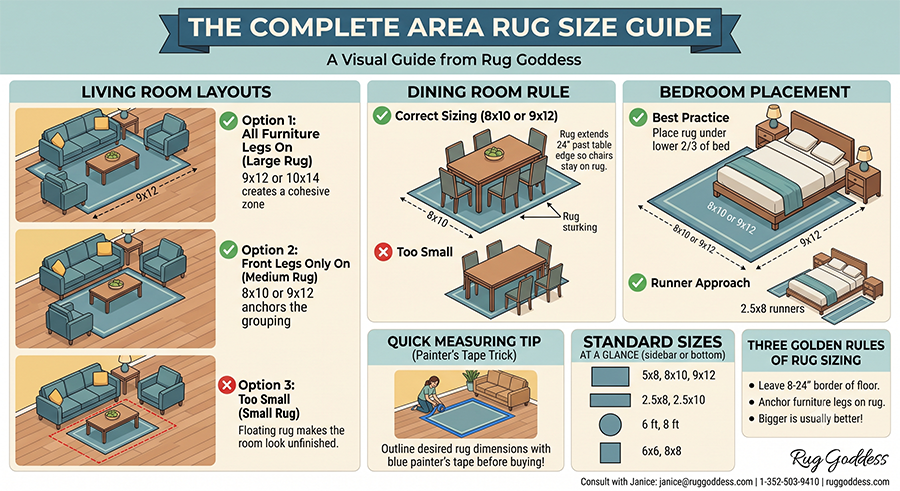
Most area rugs are produced in a handful of standard dimensions. Knowing these will make every decision below easier:
Rectangular rugs: 2x3, 3x5, 4x6, 5x7 (or 5x8), 6x9, 8x10, 9x12, 10x14, and 12x15.
Runners: 2x6, 2.5x8, 2.5x10, and 2.5x12.
Round rugs: 4 ft, 6 ft, and 8 ft.
Square rugs: 6x6 and 8x8.
Standard sizes are almost always the most cost-effective choice because they are produced at scale. When your room calls for something outside these dimensions, that is where custom capabilities come in, and I will cover that near the end.
Three Golden Rules of Rug Sizing
Before we go room by room, keep these three rules in your back pocket. They apply almost everywhere.
- Leave a border of floor showing. In most rooms, you want roughly 8 to 24 inches of bare floor between the edge of your rug and the walls. This creates a border that frames the rug and keeps the room from feeling overcrowded.
- Anchor your furniture. A rug should connect the pieces around it. Depending on the room, that means either all furniture legs sit on the rug or at least the front legs do. A rug that floats on its own with nothing touching it almost always looks too small.
- Bigger is usually better. When you are torn between two sizes, the larger one is the safer choice nine times out of ten. A generous rug makes a room feel intentional and complete. Unless, of course, the larger rug extends too far into a walkway, which could be a tripping hazard.
Now let’s get specific.
Planning Before You Buy: How to Measure and Visualize
Standard sizes give you a starting point, but a little planning makes sure your rug truly fits your space. Here is the process I walk my clients through before we ever settle on a size.
Measure the seating area first. Start with the space where the rug will live. In a living room, measure the footprint of your sofa and chairs to determine the area you need to cover. Your goal is a rug large enough to hold the furniture grouping comfortably. In a more modern space, it is perfectly acceptable to place only the front legs of your furniture on the rug. When in doubt, lean toward the larger size rather than the smaller one.
Consider your room layout. The arrangement of your furniture matters as much as the dimensions. If you have a centralized seating group, such as a sofa and chairs pulled together, choose a rug that extends slightly beyond the furniture. If your pieces sit against the walls, a rug that covers the main seating area and leaves some floor between itself and the walls will look balanced.
Define separate zones in open floor plans. In open-concept spaces and large rooms, you can use multiple rugs to define different areas. A rug under the dining table anchors the dining zone while a second rug grounds the living area. Just be sure each rug is sized correctly for its own zone and that there is comfortable space between them.
Mind your room proportions. Scale is everything. In a smaller room, a larger rug can actually make the space feel more open and intentional. In a larger room, an undersized rug tends to look lost and out of proportion. Aim for a size that harmonizes with the room's overall scale.
Account for your room shape. Square rooms pair beautifully with a square or round rug. Rectangular rooms usually call for a rug that follows the room’s proportions and helps elongate the space. If you want to soften a room or break up a lot of straight lines, a round rug is always a lovely option. (For more on styling these, see my post on the dos and don’ts of styling a round rug.)
Protect your traffic flow. Your rug should never interfere with the main paths people walk through a room, unless it’s a hallway runner. A rug that creeps into a walkway can become a tripping hazard, so keep your busiest routes in mind when choosing its size and placement.
Use the painter’s tape trick. Before you commit, outline the rug’s dimensions on your floor with blue painter’s tape or a tape measure. Seeing the actual footprint in your room is one of the simplest and most reliable ways to judge whether a size feels right, and it takes the guesswork out of the decision. Make sure not to leave the tape on the floor for an extended period.
With that groundwork in place, let’s look at the right sizes room by room. For a deeper walkthrough focused on placement, my companion post on where an area rug should be placed in a room pairs perfectly with this guide.
Bathroom Rugs and Runners
Bathrooms are small, so your rug choices are scaled accordingly, but they make a big difference in comfort and warmth underfoot.
In front of a single vanity or sink: A 2x3 or 2.5x4 accent rug is the classic choice.
In front of a tub or shower: A 2x3 or 3x5 depending on how much coverage you want.
Galley bathrooms or double vanities: This is where a runner shines. A 2x6 or 2.5x8 runner laid down the length of the room ties the space together beautifully.
Larger primary bathrooms: You can go up to a 4x6 in an open area or place a runner along the vanity with a small rug at the tub.
For bathrooms, I always recommend a washable or low-pile option given the moisture. If you are not sure what holds up best in a busy bathroom, that is exactly the kind of question I love to answer during a consultation.
Bedroom Rugs
The bedroom is all about that soft, grounded feeling when your feet hit the floor in the morning. Your rug size depends on your bed size and the look you want.
The most popular approach is a single large rug placed under the lower two-thirds of the bed, extending well past the sides and foot so you step onto softness on three sides.
- Twin bed: 5x8 placed under or beside the bed.
- Full or Queen bed: 8x10 is the sweet spot, with 9x12 if you want generous coverage and are lucky enough to have the floor space to accommodate.
- King bed: 9x12 is ideal, and 10x14 works beautifully in a large primary suite.
The runner approach: If you prefer to leave the floor exposed, you can place a pair of 2.5x8 runners on each side of the bed, sometimes with a third at the foot, depending on your room's size. This is a lovely option in rooms with beautiful flooring that you want to show off, but ideally, to achieve a finer resort-style quality in your master bedroom, the larger rug is the better choice.
Guest rooms and smaller bedrooms: A 5x8, 6x9 or 8x10 usually does the job nicely.
Formal Dining Room Rugs
Dining rooms have the clearest size rule of any room, and it is one people miss all the time. Your rug needs to extend at least 24 inches beyond all edges of your table. This ensures that when guests pull their chairs out to sit down, the back legs stay on the rug rather than catching on the edge. Keep in mind that if you have armchairs, they require a little extra room to pull the chairs out comfortably without going off the rug.
Here is how that translates by table size:
- 4-seat table: 6x9 or 8x10
- 6-seat table: 8x10, 8x11 or 9x12
- 8-seat table: 9x12 or 10x14
- 10+ seat or banquet-length table: 12x15 or custom rug.
Round dining tables look stunning on a round rug or a square rug. An 8-ft. round rug comfortably accommodates a table that seats 4 to 6 people.
If your dining table is an unusual length, this is one of the most common reasons my clients choose a custom size. Getting that 24-inch clearance right is worth it every single time.
Breakfast Areas and Eat-In Nooks
Breakfast areas are smaller and more casual than formal dining areas, so your rug can be too. The same 24-inch chair clearance principle still applies, but the furniture tends to be smaller.
- Small bistro or 2-seat table: 5x8
- Standard 4-seat breakfast table: 6x9
- Round breakfast nook: A 6 ft round for a smaller table, or 8 ft round for a larger one.
For breakfast areas, where spills happen, I steer many clients toward washable or indoor-outdoor constructions that look refined and clean up easily.
Bar Areas
Home bars and barstool seating are among my favorite spaces to style because the right rug adds instant warmth and personality.
- Behind a bar or along a bar wall: A 2.5x8 runner defines the space and protects the floor.
- In front of a bar with stools: A small accent rug (3x5 or 4x6) or a runner sized to the length of your bar works well. Some people prefer to leave this space rug free; it all depends on the amount of traffic.
- Wet bars or high-traffic entertaining zones: Low-pile or indoor-outdoor constructions withstand spills, ice, and foot traffic.
Family and Entertainment Rooms
These rooms get the most use, so they need a rug substantial enough to unite a large seating arrangement, often around a sectional or a media setup.
For family and entertainment rooms, I almost always want all furniture legs to sit on the rug, which keeps the space feeling cohesive.
- Standard family room: 8x10 or 9x12
- Room with a large sectional: 9x12 or 10x14
- Open-concept great rooms or media rooms: 12x15 or a custom size
Because these rooms handle kids, pets, snacks, and movie nights, durability matters as much as size. I can guide you to constructions that handle real life while still look beautiful and high-end.
Formal Living Rooms
Formal living rooms call for a more composed, elegant arrangement, and the rule here is slightly more flexible.
- Smaller seating groups: 8x10 with the front legs of your sofa and chairs resting on the rug.
- Larger or open living rooms: 9x12 or larger, ideally with all furniture legs on the rug for a polished, intentional look.
- A floating conversation area: A 5x8 can work if it is sized so the front legs of all the surrounding pieces touch it.
The key in a formal living room is that the rug should feel like it gathers the furniture together rather than sitting apart from it.
Hallway Runners
Hallways are made for runners, and the right runner adds warmth, reduces noise, protects high-traffic flooring, and is safer.
The guideline I follow is to leave roughly 4 to 5 inches of floor showing on each side of the runner and about 12-18 inches at each end. This keeps the runner centered and balanced.
- Standard hallways: 2.5x8 or 2.5x10
- Long hallways: 2.5x12, or a custom-length runner
Hallways are among the most frequent places where my clients need a custom length, since very few homes have a hallway that exactly accommodates a standard runner rug.
Kitchen Rugs and Runners
Kitchens benefit enormously from rugs, both for comfort underfoot and for the warmth they bring to a hardworking space.
- In front of the sink: A 2x3 accent rug, or a 2.5x7 runner if you want more coverage.
- Galley kitchens: A single runner (2.5x8 or 2.5x10) down the center of the space.
- Between an island and the counter or range: A runner sized to roughly the length of your island looks intentional and pulls the kitchen together.
In kitchens, washability and low pile are your friends. There are wonderful options now that look like fine wovens but go straight into the wash.
Stair Runners
Stair runners are special because they are custom by their very nature. There is no standard size that fits a staircase, since every set of stairs has its own number of steps, tread depth, and riser height.
Here is what determines your stair runner:
- Width: Standard runner widths are 27 inches and 31 inches. You generally want about 3 to 4 inches of the stair showing on each side of the runner.
- Length: This is calculated from the tread depth plus the riser height, multiplied by your number of steps, plus any landings. Basically, I usually figure 21 inches for each step, and then I add the measurement of the full pattern repeat to the dimensions to have a little extra to play with the pattern when installing the runner at the foot of the staircase.
Due to several factors, I always recommend professional measurement for stair runners. Stairs are one of the areas where getting it right truly matters for both safety and beauty, and my team and I handle them from start to finish. You can browse options on our stair runner and custom runner page, and for a deeper dive into specifications and installation, read my complete guide to custom stair runners.
Outdoor and Patio Rugs
Outdoor spaces deserve the same thoughtful sizing as indoor rooms. Treat your patio like an outdoor living room and choose from our indoor-outdoor rugs built to handle the elements.
- Small balcony or bistro setup: 5x8
- Standard patio conversation set: 8x10
- Large patio or covered outdoor room: 9x12 or larger
As with indoor living rooms, you want your outdoor furniture to sit on the rug, at the very least the front legs. Choose an all-weather construction (polypropylene and similar fibers) that stands up to sun, rain, and traffic. For more on choosing the right one, see my guide to choosing outdoor rugs for your patio.
When You Require a Custom Size or Shape & How to Keep Cost in Mind.
Sometimes a room simply will not cooperate with standard sizes. Maybe you have an oversized great room, an extra-long hallway, a walkway in a weird spot, a uniquely shaped foyer, or a dining table that needs that exact clearance. This is one of my specialties, and I can create virtually any size and any shape, including large-format pieces well beyond what most stores even offer. You can start browsing in our full rug collection.
I always want you to make a smart decision for your budget, so here is my honest guidance on cost:
- Standard sizes are the most economical. They are produced at scale, so if your room fits a standard size, that is almost always your best value.
- Bound broadloom is an affordable custom route. When you need a specific dimension, having a quality carpet cut and bound to your measurements is often more budget-friendly than a fully custom woven rug, and it lets you match an exact dimension.
- Fully custom and oversized rugs cost more because of the additional materials, craftsmanship, and time involved. They are worth every penny when the space calls for it, and I will always tell you honestly when a custom piece is the right investment and when a standard size will serve you just as well. If you are curious about what drives rug pricing, my post on why area rugs are so expensive breaks it down honestly.
See It in Your Space Before You Decide
High-res images on a page are helpful, but seeing a rug in your actual room is even better. With our RoomVo room visualizer, you can upload a photo of your space and preview how different rugs and sizes will look right where they will live. It removes the guesswork out of the decision.
Let’s Find Your Perfect Size Together
Choosing the right rug size does not have to be overwhelming. Whether you are furnishing a single bedroom or coordinating rugs across an entire home or office, I would love to help you get it exactly right the first time.
Schedule your consultation, in-home or virtual, whichever works best for you. You can reach me directly at 1-352-503-9410, email me at janice@ruggoddess.com, or visit ruggoddess.com to get started. I will stay with you every step of the way, from measuring to delivery.
Related Reading
For more expert guidance from the Rug Goddess blog:
- Where Should an Area Rug Be Placed in a Room?
- How to Easily Select an Area Rug for Your Home
- The Complete Guide to Custom Stair Runners
- Transform Your Patio: A Guide to Choosing Outdoor Rugs
- Dos and Don’ts When Styling Your Round Rug
- Why Are Area Rugs So Expensive? An Expert Buying Guide
- Which Area Rugs Are Best? An Expert Guide
- Does a Dark or Light Rug Make a Room Look Bigger?
- Why Does Your Area Rug Need a Pad?
Frequently Asked Questions